
admin
- November 21, 2025
World Youth Alliance Africa held an online Masterclass on the Human Dignity Curriculum. The Human Dignity Curriculum is a global K-12 program which teaches children and young people about personal identity, human dignity, and excellence. The HDC helps students answer the big questions, such as ‘Who am I?’ and ‘What can I become?’. This grounds every grade level in the idea that all people are equal in dignity, which is a powerful concept to teach the future leaders of our generation.
This online Masterclass brought together a group of educators, youth leaders, and policymakers from Kenya from October 9th to 21st, 2025. This Masterclass created a platform for learning and collaboration, which highlighted the importance of having a practical framework for education systems. This is because school is the place that young people spend the better part of their formative and early years. Education systems should therefore nurture students’ moral, intellectual, and emotional development. This will help these young minds grow to engage in policy processes and discussions, especially those that address their needs as young people.
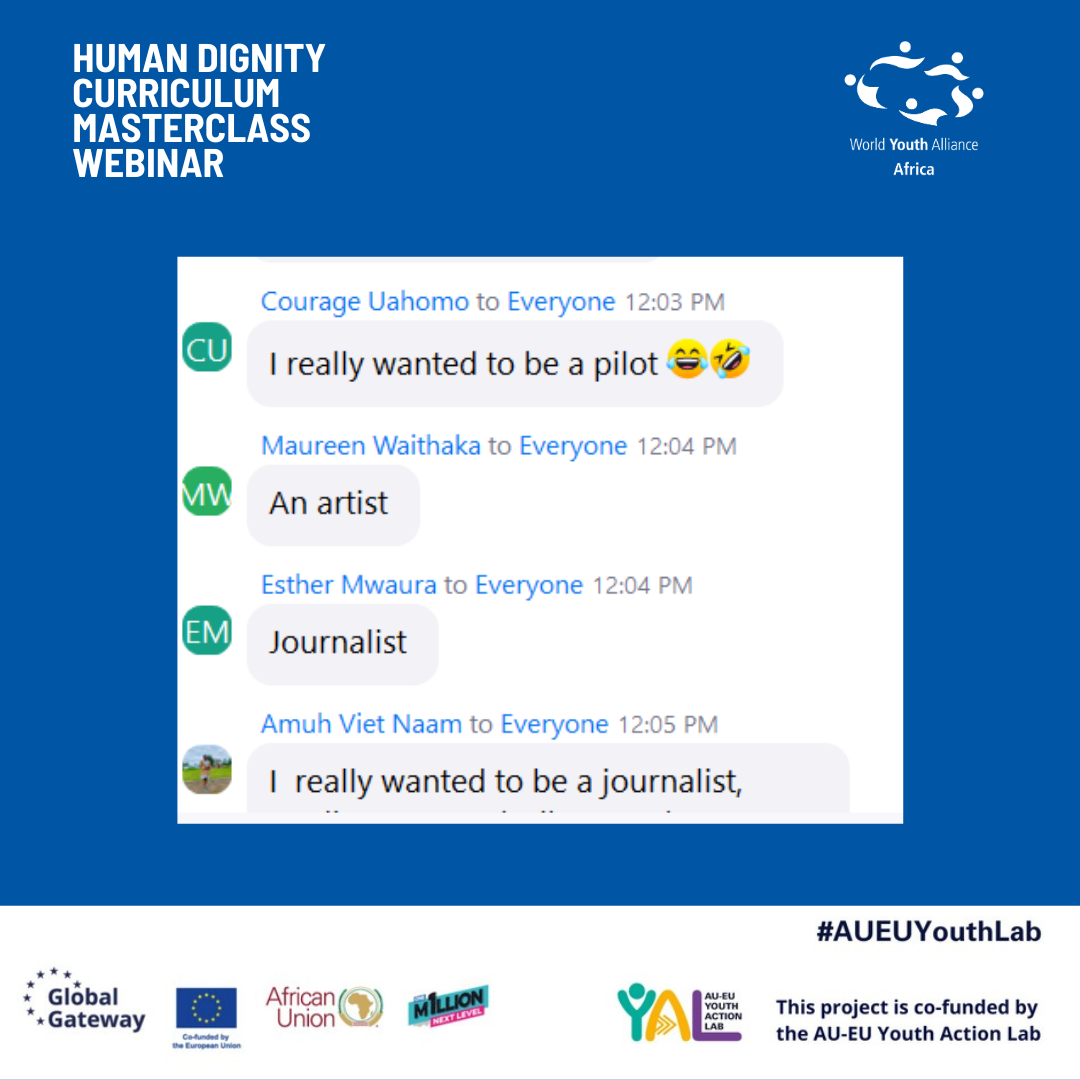
The main objectives of the Masterclass series were to engage young people, policymakers and education stakeholders in dialogue on nurturing students’ holistic growth. Throughout the sessions, participants engaged in meaningful discussions, exchanged experiences, and reflected deeply on the role of education in shaping not just knowledge, but character and values.
The WYA Africa team set the tone of this Masterclass by providing a detailed and informative presentation on what the Human Dignity Curriculum (HDC) is. This also highlighted the work we do in the education sector.
This informed how we conducted our sessions and the topics we covered. We covered four main topics
- An Introduction to the Human Dignity Curriculum (HDC)
- Education for Human Flourishing: Linking Policy, Values, and the Potential of Young People
- Shaping values through Policy and the place of the HDC in National Development
- Teachers as Custodians of HDC in Education- highlighting opportunities and challenges
We were interested in discussing the connection between policy, values, and the potential young people have in ensuring education is aimed towards human flourishing. This is because we are interested in equipping young people with all the necessary skills to feel supported and empowered enough to impact policy and be changemakers in their community, no matter how small. Our speaker highlighted that education must go beyond academics to nurture purpose, values, and leadership for sustainable development to be realised. It is important to champion the intersection of education, equity, and human development, inspiring young people to lead with vision, empathy, and integrity while placing the human person at the centre.
We also had a speaker from the Senate of Kenya who spoke about election processes and how young people can develop impactful campaigns and governance frameworks. The speaker highlighted the importance of using evidence-based communication, engaging in policy research, stakeholder engagement, and empowering young people to contribute to social transformation.
Additionally, we spoke about the role of teachers as custodians of HDC in education. Hearing the reflections of an experienced teacher, we learned the importance of a lifelong learning culture, engaging in research that helps learners uphold human dignity, promoting engagement, and providing holistic learning for every student. The speaker highlighted the importance of realising more teacher-student relationships and their role as custodians of human dignity to ensure every learner feels supported, valued, and respected.
Furthermore, we had a speaker who discussed the opportunities and challenges of embedding HDC in Kenya’s education reforms. This session examined the importance of distributing financial aid effectively and equitably among learners in Kenya. This speaks to securing the future of children through education, as this fosters lifelong learning, societal development, and responsible citizenship. This echoed the speaker’s view: “Let our schools be sanctuaries of dignity.”
All in all, the Masterclass series emphasised that education grounded in human dignity recognises the intrinsic worth of every person and sees each student as capable of making meaningful contributions to society. Participants shared how this approach contrasts with systems that focus solely on academic performance or economic productivity.
At WYA Africa, we aim to empower young people not only to understand their worth but to actively shape the systems, governance structures, and societies in which they live.
